Inside a growing movement to ditch smartphones and unplug by choice
Some Americans are trading touch screens for flip phones as part of a growing “offline” movement
(InvestigateTV) — More than 90% of Americans now own a smartphone, but some people are purposefully trying to dial back their use.
It comes as a growing body of research links excessive screen time and social media use with increased irritability, anxiety, depression and disrupted sleep.
A month without a smartphone
Aida Ebrahimi now carries a notebook to write down directions by hand instead of relying on GPS.
“The mechanical motion of writing down kind of imprints it in my memory,” Ebrahimi said.
Even if she gets lost, she said she can “always ask someone else for directions.”
Ebrahimi is taking part in a program called Month Offline, which asks participants to turn off their smartphones, log off and “link up.” The program started with signs posted around neighborhoods in Washington, D.C.
“The program is a way to just encourage you to think about your relationship with internet and technology and communication,” Ebrahimi said.
Grant Besner co-founded Month Offline and has been mostly smartphone-free himself for the last few years.
“We kind of referred to it in the early days as like a support group for screen addicts,” Besner said.
“I sleep better. I call the people in my life that I care about a lot more. I read a lot more. And I don’t use my phone to escape or to decompress,” Besner said.
Besner said the program shows people that going without a smartphone is doable, and that signing up as part of a group means participants don’t have to do it alone.
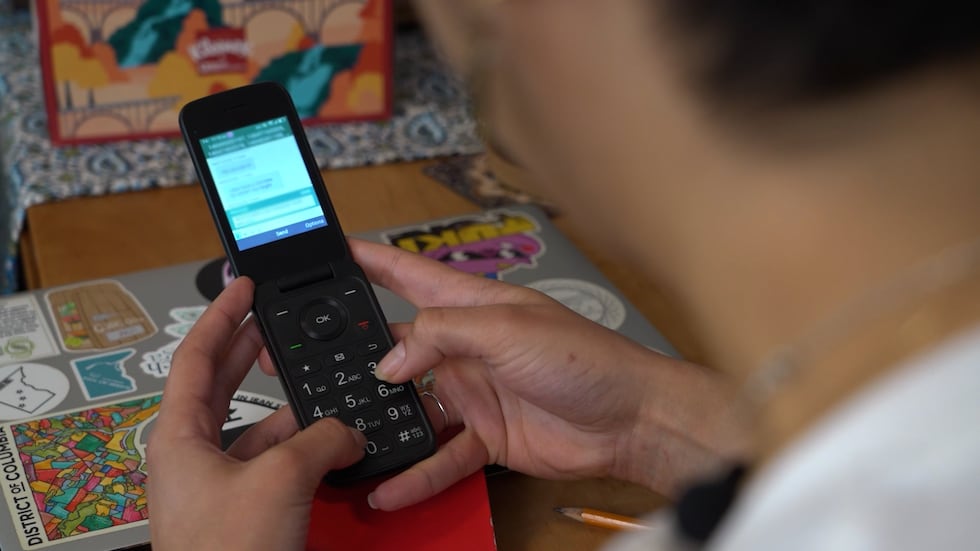
“It’s five meetups. The first meetup, you meet each other, you sign a pledge where you commit to getting off your touch screen for 30 days. And we provide you with a working dumb phone,” Besner said.
Participants receive a flip phone, and the program costs about $100.
Besner said the hope is that the experience allows people to connect with others in real life, while developing a healthier relationship with technology.
“I think there’s a very individual aspect of either you’re returning to your smartphone with a healthier relationship, or that you can feel comfortable putting it away for some amount of time,” he said.
Ebrahimi said hours once spent scrolling are now filled with art projects and time outdoors.
“One day to the next I’m like wow I see more flowers, more leaves, more birds,” Ebrahimi said.
“There’s a lot more presence,” Ebrahimi said.
Ebrahimi explained why she ultimately decided to try the Month Offline program.
“I’m originally from Iran, so when the protests happened in January in Iran, I was using my phone constantly. I was listening to podcasts, I was also using social media a lot, and I just felt like there’s this heavy sense of urgency for me to take a break from everything. I said, I desperately need to get off of my smartphone,” Ebrahimi said.
From Silicon Valley to ‘app-stinence’
Gabriela Nguyen grew up in Silicon Valley and had access to smartphones and screens from a young age.
“I grew up in Silicon Valley. I had a lot of these technologies from a very young age,” Nguyen said.
Nguyen describes herself as a former smartphone and screen addict. She said her turning point came at age 14.
“I was doing homework late at night. Should have only taken me 20 minutes to do this assignment, but it took me several hours and I stayed up to like an ungodly hour because I kept getting distracted by my phone,” Nguyen said.
Nguyen calls her approach “appstinence.”
“So I define appstinence as not using technology that is designed to be addictive,” Nguyen said.
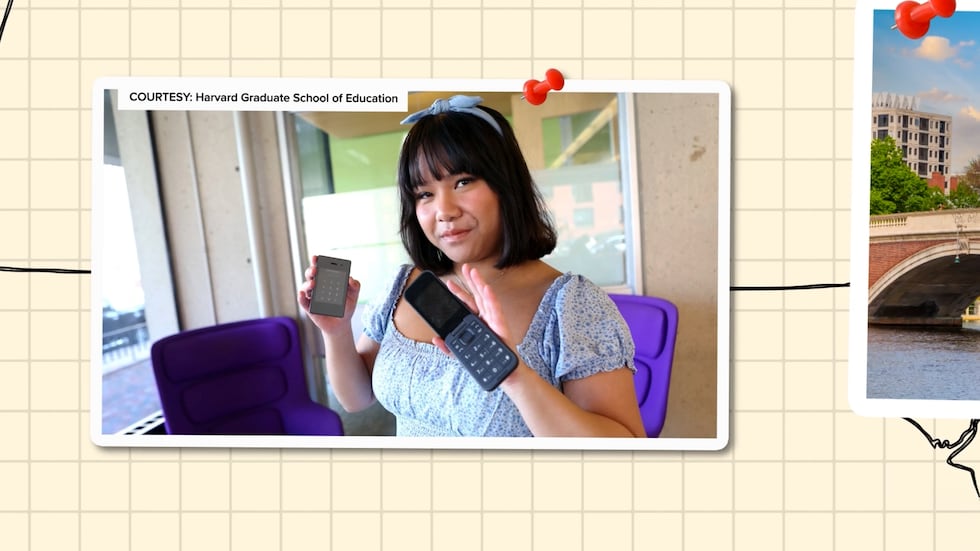
Nguyen started AppStinence as a student organization while attending Harvard. At 24, she now works full time educating others about abstaining from certain technologies.
“The biggest questions are how do people go about what would seem like very basic tasks of their day, things like two-factor authentication, or like track my workout or something like that. And the reality is there’s workarounds to this. But then I think what people realize is that sort of ‘inconvenience’ is the goal,” Nguyen said.
Nguyen mostly uses a flip phone and has a laptop as well.
“Instead of making it where my email is on a smartphone and the notifications are on and I get every single email as they come in, I only check them on my laptop. And then I only check them at certain times of the day,” Nguyen said.
Nguyen believes the future of tech is “less of it.”
" I think that the demand of my generation for another way to live is strong enough for us to make substantive changes," Nguyen said.
A college course on digital detox
Dr. Shreya Hessler, a practicing psychologist and affiliate professor at Loyola University Maryland, recently taught the school’s first “Digital Detox Psychology” course.
Hessler said not a single student dropped out of the class.
“It’s not just about not using technology. It’s about how is that impacting our psychological functioning, our social functioning — because now there’s more conversation about the harm that digital interface causes us as humans,” Hessler said.
Hessler’s classroom is tech-free. She said students told her they could not remember the last time they played or had fun without a device.
“They shared with me that they couldn’t remember the last time they had played, the last time they had fun without a device,” Hessler said. “And so I decided we’d play flag football for 25, 30 minutes on the quad on campus.”
Hessler also challenged students to participate in 24- to 48-hour digital “fasts.” She said she began to notice changes by mid-semester.
“Just this beautiful shift, shoulders relaxing, more eye contact with each other in the classroom. And they just opened up more,” Hessler said.
“I love all of the different ideas and strategies people are putting into play to have agency and ownership over their relationship with technology,” Hessler said.
What comes next
As Ebrahimi’s Month Offline program ends, she said she plans to keep using her flip phone.
“I think I want to keep going with this with the flip phone,” Ebrahimi said.
“What would you say to someone who’s like there’s no way I can give up my smartphone?” Graf asked.
“There’s always a way. Even if it’s just for a day, put your smartphone in a box and go out on a walk for an hour. We need it. We need it,” Ebrahimi said.
Experts we spoke with shared some similar advice for anyone looking to try a digital detox.
They say the key for most people is to start small. Consider putting your phone outside your bedroom at night or perhaps trying a smart-phone free day or weekend.
“Research suggests that people check their phones hundreds of times a day, and it’s become so automatic that in order to break out of it the best solution is to basically put the phone away,” said Kostadin Kushlev with Georgetown University’s Happy Tech Lab. “It doesn’t have to be anything fancy.”
Meanwhile, organizers of the “Month Offline” program told us they’ve now expanded, with cohorts running in several different cities.
They say about 70% of participants have opted to keep that flip phone when the month is over.
Copyright 2026 Gray Media Group, Inc. All Rights Reserved.